Blog – Strip Flying Day 30/01/2022
This is going to be a long one……
Today started off with low cloud base and winds around 15-20kts for our strip flying day, However the weather did improve and we managed all targets for the day. Short field work is another beast entirely from the standard paved runway work. Man I was working!
Airstrips:
RWY34@NZPP (Paraparaumu)
RWY28@NZKP (Koputaroa)
Northern Sector @ Kaitoke
There is so much to consider as described below:
Short field take-off and landing
A short (or minimal) field is one where the runway length is shorter than that normally available for the conditions, but is still sufficient for take-off and/or landing. It’s not one that is too short. Nor is it one where the runway length is unknown.
When a runway group number is not available, or is available but less than the aeroplane’s group number, reference must be made to the Flight Manual to ensure there is adequate runway length available under the existing conditions. As a rule, if doubt exists under any circumstances, refer to the Flight Manual.
Performance (‘P’) charts, where available, are a valuable source of take-off performance information. Manufacturer’s graphs in Flight Manuals should be used in the absence of P charts. If using the latter, it’s recommended that pilots apply the appropriate surface correction factors from Advisory Circular 91-3 Aeroplane performance under Part 91.
An approach to a field where the runway length is unknown, or is known to be too short, may occur during the precautionary landing. This is an emergency procedure, but the approach technique is the same as for a short field landing.
The Take-off and landing performance GAP booklet is a useful reference for this lesson.
Objectives
To ensure, by calculation, that there is adequate runway length for take-off and landing in accordance with the aeroplane’s performance data.
To apply sound decision making principles before adopting the recommended procedure for take-off or approach for a runway of minimal length.
To operate the aeroplane in accordance with the manufacturer’s recommended short field techniques in order to obtain the best possible performance.
Take-off considerations
Temperature
The most important effect of temperature is to change density. An increase in temperature will result in a decrease in density. Since the expected engine performance is based on a standard temperature of 15 degrees Celsius at sea level, a correction will need to be made for the actual or ambient temperature.
If you’re in the aeroplane, on the field of take-off, the aeroplane’s outside air temperature (OAT) gauge gives ambient temperature. Otherwise, this information is provided in a METAR, if available.
Density
Density also affects the indicated airspeed (IAS). As density decreases, IAS decreases. Therefore, as the density decreases, the aeroplane’s actual speed (TAS) will need to be increased to achieve the same IAS for any given rotate IAS. This will increase the length of the take-off roll, but the effects of density on engine performance are far more critical.
Pressure altitude
The calculation of pressure altitude (PA) is vital for take-off, as this corrects the aerodrome elevation under the existing conditions to an elevation within the standard atmosphere, and the standard atmosphere is what the expected engine performance is based on.
If you’re on the aerodrome of take-off and in the aeroplane, you can simply set 1013 hPa on the altimeter sub-scale and read off the pressure altitude. However, if you’re not on the aerodrome of take-off, you need to know the aerodrome’s QNH (from the METAR) and elevation (from the aerodrome chart) in order to calculate pressure altitude.
Aeroplane weight
The aeroplane’s weight is derived from the weight and balance calculations and will directly affect the take-off and climb performance.
Runway surface
The take-off roll is reduced on a firm or sealed surface compared to a soft or grass surface, as there is less surface friction. Since the take-off performance figures provided in the Flight Manual must be calculated using known parameters, a grass surface is defined as short dry grass. Long or wet grass will markedly increase the take-off distance.
Slope
An up slope increases the take-off distance and a down slope reduces it. The slope of a runway, as a percentage, is given in the operational data on the aerodrome chart in the AIP Vol 4.
Headwind component
When the wind is at an angle to the runway in use, the headwind component will need to be calculated. Use the chart provided in the Flight Manual.
Wind
If strong or gusty winds are present, there is always the possibility of windshear in the climbout. If a decrease in wind speed is suddenly encountered during take-off, additional power will not be available to arrest the sink. Therefore, the rotate speed (VR) and the take-off safety speed (VTOSS ) are increased by an appropriate amount to counter the possible effects of windshear.
For steady wind speeds of 10 knots or less, use the book figures.
For winds above 10 knots, this speed is progressively increased (refer CFI and Flight Manual).
Whenever the rotate, take-off safety speed or best angle-of-climb speed needs to be increased because of the conditions, think about whether to continue with the exercise.
Calculation
The calculation of the required take-off or landing distance should be a relatively simple process that encourages its regular use and the application of ADM principles.
The use of performance graphs should have been covered in previous lessons.
Collect all the necessary information and consult the Flight Manual to determine the required take-off distance.
The take-off performance graphs in most light aircraft Flight Manuals provide only one weight, all up weight (AUW). This is because the range of weights for take-off or landing is insignificant and, since AUW cannot be exceeded, provides a safety margin at lower weights. Larger aircraft Flight Manuals provide two or more weights. Where only an AUW is given, lesser weights cannot be extrapolated. AUW must be used regardless of the aeroplane’s actual weight.
Using either P charts where available, or the Flight Manual performance data, plus AC91-3 surface correction factors, calculate the distance for take-off under the existing conditions. Compare this with the distance available, as given in the aerodrome chart’s operational data, or as determined by other means.
If the take-off distance available is less than the take-off distance required – walk away!
If the take-off distance available is equal to or slightly more than the take-off distance required – think carefully!
Double-check your calculations. Have all factors been properly taken into account?
Remember that an accurately performed short field take-off will be required in order to ensure that the performance data contained in the Flight Manual is met.
Take-off performance figures are based on shiny new engines and propellers – how does this aeroplane compare? Is the surface short dry grass or a bit long? How important is it that a take-off be conducted now – under these conditions – and how will the conditions be affected by a delay?
The calculated take-off distance to a height of 50 feet assumes full power is applied before brake release and that the stated flap setting is used. The distance required for take-off includes the ground roll and the distance travelled over the ground to reach a height of 50 feet at the take-off safety speed (VTOSS) which is based on the aeroplane’s stall speed and therefore varies with the weight.
The take-off safety speed (VTOSS) is the speed to be achieved after lift off and before a climb above 50 feet. Although, for most light training aeroplanes, it’s commonly the same speed as the best angle of climb speed (VX). However, this speed does not usually include the use of flap (refer to Flight Manual for manufacturer’s recommended procedures and/or CFI).
Some Flight Manuals have two take-off charts, one without flap and another with flap. The use of flap is often recommended for take-off from a soft field or where obstacles are present in the climb-out path (refer Flight Manual). This is because the increase in lift provided by flap allows the aeroplane to lift off sooner at a lower airspeed, thereby minimising the ground roll and surface friction.
Commonly, a lower take-off safety speed (VTOSS) is nominated when flap is used. This is because flap lowers the stalling speed, making a lower take-off speed possible. In addition, the decreased groundspeed resulting from the lower climb airspeed allows a similar angle to the best angle, to be achieved.
Take-off distance calculations should be based on the appropriate performance figures, depending on whether flap is recommended for take-off or not.
Unless all of these are complied with, calculation of the required take-off distance is negated.
As this exercise is not generally carried out from minimal length fields, remember to advise students that such conditions are being simulated.
Do not allow the student to round off the rotate or take-off safety speed to the nearest mark on the airspeed indicator. For example, take-off safety speed 54 knots, which is “near enough to 55 knots”. This exercise requires accurate flying skills, and these only come from practice. Although one knot may make no appreciable difference to the aeroplane’s performance, this practice will ultimately make a considerable difference to the student’s attitude towards performance.
Landing considerations
Aerodrome elevation or pressure altitude
Because of the low power setting used on the approach, aerodrome elevation is used when calculating landing distance and the effects of pressure altitude ignored. However, an increase in altitude will result in a decrease in the air density. As density decreases, IAS decreases and the aeroplane’s actual speed (TAS) will be increased for any given indicated threshold crossing speed. Therefore, the aerodrome height above sea level will affect the length of the landing roll, and pressure altitude may be used for more accurate calculations (refer Flight Manual and CFI).
Weight
The aeroplane’s weight affects inertia and therefore the stopping distance.
Runway surface
The landing roll is reduced on a firm dry surface compared with a grass or wet surface because of the improved braking action. Remember that grass is defined as short dry grass.
Slope
An up slope decreases the landing distance, and a down slope increases it. Slope is given in the aerodrome operational data.
Headwind component
When the wind is at an angle to the runway in use, the headwind component will need to be calculated. Use the chart provided in the Flight Manual.
Wind
If strong or gusty winds are present, there is always the possibility of windshear on the approach. The approach and target threshold speeds (VTT) are increased by an appropriate amount to counter the possible effects of windshear.
For steady wind speeds of 10 knots or less, use the book figures.
For winds above 10 knots, this speed is progressively increased (refer CFI and Flight Manual).
Whenever the approach or threshold speed needs to be modified, consider whether to continue with the exercise. The answer may be affected by the excess runway available over that required.
Calculating the landing distance
With the necessary information collected, the Flight Manual is consulted in order to determine the landing distance required.
The calculated distance for landing under the existing conditions is compared to that available, which is given in the aerodrome chart’s operational data.
If the landing distance available is less than the landing distance required – walk or fly away!
If the landing distance available is equal to or slightly more than the landing distance required – think carefully!
Double-check your calculations. Have all factors been properly taken into account?
Remember that an accurately performed short field landing will be required in order to ensure that the performance data contained in the Flight Manual is met.
The Flight Manual for each aeroplane type states the maximum speed for crossing the threshold, and the flap setting to be used.
The required landing distance in the Flight Manual is calculated from a height of 50 feet above the threshold in the stated configuration. That is, the distance required for landing includes the distance to touch down from 50 feet over the threshold and the ground roll to a full stop.
Crossing the threshold higher than 50 feet, using less than full flap, or crossing the threshold at a higher airspeed, will increase the landing distance.
Airmanship
Pilots should consider their own ability before attempting a take-off from or landing onto a runway of minimum length.
The decision-making considerations of a normal take-off apply; but additional decision making is required in relation to a strong or gusty wind and EFATO.
The possibility of EFATO during a short field take-off requires an amendment to the take-off safety brief. Rather than simply lower the nose, as a result of the very high nose attitude and the low airspeed during the initial climb out, the brief is modified to emphasise immediately and positively lowering the nose.
Discuss the decision making required when deciding to go or to abort the take-off or landing.
Aeroplane management
Full power before brake release is confirmed by checking that the required static RPM is being achieved. This figure (often stated as a range, eg, 2280 to 2380 RPM) is in the Flight Manual.
If static RPM is not achieved, simple ADM should result in a logical sequence of: full power is not achieved therefore, maximum performance cannot be achieved, and therefore, the take-off must not be attempted.
Have an aircraft engineer check out and clear the problem before further flight.
There are a few reasons why static RPM may not be achieved, and consideration of these requires the application of a higher level of ADM.
Icing
Check for carburettor ice and that the carburettor heat control is set to COLD. If this cures the problem, continue with the take-off.
Instrument error
Is this RPM normal for this aeroplane? Has this RPM reading been confirmed by the engineers as indicative of full power in this aeroplane? (If so, why is this state of affairs acceptable? Refer CFI).
Propeller
Is the propeller in good condition, and is it the same propeller installed by the manufacturer on which the static RPM is based. Or has it been replaced with a propeller of coarser pitch?
These last two possibilities cannot be confirmed while sitting at the holding point; taxi back to the start-up area and consult an aircraft engineer.
Human factors
Vision may be affected by the high nose attitude on take-off and terrain ahead may produce a false horizon. Therefore, regular cross-reference to instruments is emphasised.
During an approach to land, perception may be influenced by the visual cues of surrounding terrain, a false horizon or runway length and width. Therefore, regular cross-reference to instruments is emphasised.
So……… That’s all there is to it.
After a good solid briefing the group commenced training on short field techniques on 34 Grass at Paraparaumu.
The C172 Team of myself and 1 other pilot shared the load of fuelling and pre-flight then I was in the back whilst my teammate did her training which consisted of 2 take-offs and landings. Then it was my turn.
Short Take-off configuration is normal at 10deg of flaps but you stand on the brakes and give it full power. Once at 2300rpm release the brakes and away you go. Rotation is at 55kts and pull up to Vx (Maximum Angle of climb) and 61kts. Once at 200ft we can lower the angle to Vy (Maximum Rate of Climb) and climb at 75kts. That part of the exercise was ok but I got a good buffeting in the initial climb which chucked us around a bit.
A standard circuit was done after climb out and then slowed the aircraft way down on base and finals to 61kts again. This speed seems like you might fall out of the sky and is quite nose down. However I discovered you need to really stick to the numbers so I had my work cut out.
Also the final leg is slightly further as 34 grass threshold is much further into the field than 34 seal. Somehow with the guidance of my FI I managed to land well and apply brakes whilst cleaning up the flaps. yay my first real short field take-off and landing! Awesome! A taxi back to 34 grass and rinse and repeat.
My second approach and landing was better as my FI didn’t have quite the same urgency in his commands so I must have been improving.
Another good landing then it was back to 34 grass for a departure to the North and heading to Koputaroa.
Koputaroa is a private strip just outside Levin. I had flown over it previously and on the journey there i was thinking how the heck am I going to land on that wee thing? Compared to 34 seal at NZPP which is 1187m x 45m, Koputaroa is 550m x 20m and has powerlines 100m from the end we were planning on landing at. What are my instructors trying to do to me?
It took some looking to find the strip as every paddock looks the same when you are flying but I found the strip and was guided into the overhead join.
Once I got all set up for the landing 61kts and full flap, I turned onto finals and the “Pucker Factor” kicked in. I was guided in once again by my FI who kept alternating between Less power/More power, Nose down/Nose up, A bit high/A bit low More power, more power!, but at the last minute we were just too high and he called “go around!” Yep if it ain’t right, go around. Second bite at the cherry and I am really working the pitch and power to keep on the numbers. This time I got the down and a nice landing too. Sweet!
I cleaned up the aircraft and taxied to the parking point and shutdown. Phew! I am sweating like mad but so chuffed. Time to climb out and take a wee look at this strip.
It always looks so much bigger when you walk down it. Its a nice place. Rural as. Milking sheds and the farmers house on one side, and paddocks on the other.
After a pre-flight it was time for my teammate to do her two circuits which she did exactly the same as me with the first one aborted and a nice one second. I think we are getting the hang of this!. Once the second attempt was completed we departed Koputaroa and headed down the coast back to Paraparaumu and lunch.
The afternoon session was a flight out to Kaitoke Airstrip in the Hutt Valley. This strip is build on a hill side and is about 650m x 40m. Usually you fly in from the North with a headwind, and out to the North with a slight tail wind. From the air this strip looks like an aircraft carrier as it is well above the valley floor.
My teammate flew us out from NZPP via Transmission Gully. It was great to see the new state highway that is so, so close now surely to be ready to open. i cant wait. But that is another story so back to the flying.
Coming into Kaitoke, even as a passenger, is quite the experience. Lots of lumps and bumps but my teammate did great job and we got in fine. Again we shutdown the aircraft and had a good look around. This is my home town so I had been here before but had never flown in. This strip has its own challenges with its height, wind, and today, with the heat and the slight drop in pressure would make the 172 a bit down on performance.
We watched as or other aircraft ( a Piper Tomahawk) landed and took off. Hmmm that used a fair bit of runway and got well tossed about around the 50 foot mark. Ok our turn. This could be interesting.
My teammate was first up. A quick turn and she gave it the gun. Hmm seems a bit slow. At our abort point we were down on power so aborted. Ok that was a first. A call by both my teammate and the instructor which was well executed. As we taxied back we all discussed what happened and our reasons for having abort points and speed targets. Perfect lesson right there!.
On the second attempt my teammate set full power earlier in the lineup and I could just feel that the speed was much improved. At the abort point we were 5kts on the plus side of the scale so our FI said keep going. We got into the air around 550ft and also got slammed about a bit. At this stage our FI said “a little too close for comfort on that take-off team so lets take that as a hint and turn for home. Sorry Mark but safety first”. I couldn’t agree more. I had absolutely no problem with a safety call.
We flew back to NZPP almost the same way as our incoming path and all too soon our home base came into view. After the days events landing on that huge seal runway was a doddle for my teammate.
What an awesome day! Smiles all round and some very tired pilots!
Happy days!
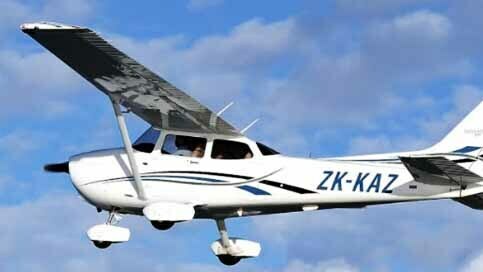
Aircraft: ZK-KAZ (Cessna 172SP Skyhawk)
Total Time: 1.1
Landings: 4
Go-arounds: 2
Visual Approaches: 4
Instrument Time: 0.0
Until next time….
For more Blogs and Digital Photos go to https://walshephotography.com
Check out Kapiti Districts Aero Club at https://www.kapitiaeroclub.co.nz
Blog – Strip Flying Day 30/01/2022